Sunday, 15 September 2013

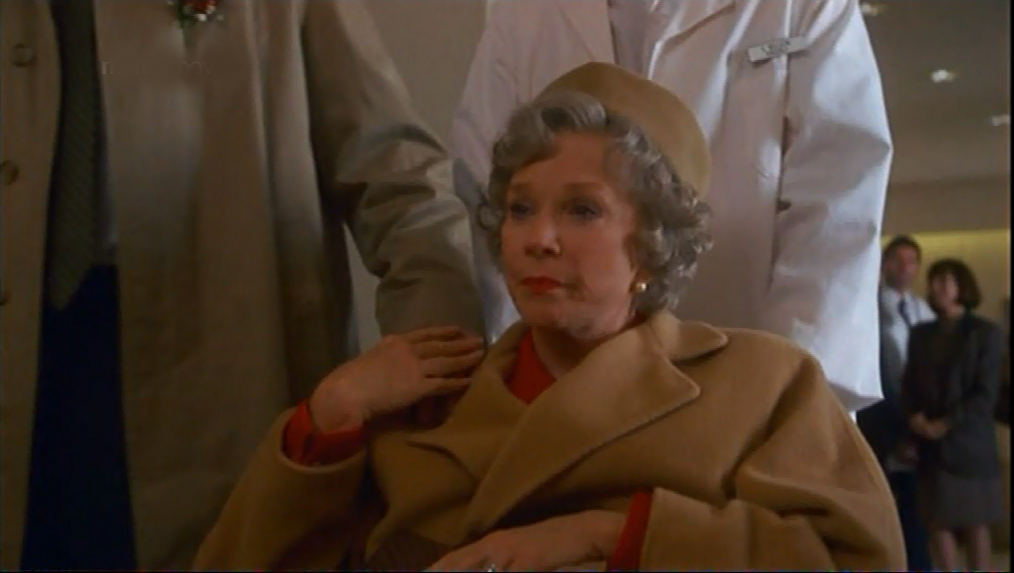
Kings Row (1942 Sam Wood)

Reminded to watch this again after seeing Neil Brand on Hollywood composers, and comparing Eric Wolfgang Korngold's epic score to the very similar sounding Star Wars theme thirty years later!

The definition of Melodrama, film is beautifully written by Casey Robinson from Henry Bellamann's novel: memorable lines such as "I'd hate God too, but there's nothing I can reach!" and the classic "Where's the rest of me?"
The two male leads aren't necessarily the best actors, but it doesn't matter: Robert Cummings, Ronald Reagan, Ann Sheridan, Betty Field (a cracking performance as Cassandra), Charles Coburn and Claude Rains (both uncharacteristically serious), Judith Anderson, Nancy Coleman (another hysterical woman), Kaaren Verne (the Austrian girl at the end), Maria Ouspenskaya (Cummings' lovable gran), Ilka Grüning (good as the maid) and Harry Davenport (sporting an elaborate Perc Westmore beard and often cutting off conversations with Parris in the middle). The kids are Ann Todd, Scotty Beckett, Douglas Croft and Mary Thomas.

Left: Scotty Beckett, Top: Douglas Croft, Middle: Unknown.

Betty Field.


Photographer James Wong Howe isn't afraid to let it get good and dark, e.g. in storm scene with Parris and Cassandra. Also loved composition of shot where we don't really notice a tell-tale syringe in the foreground.

Incest theme was one of several reported censorship problems. Also that Cassandra was pregnant is only faintly alluded to.

Korngold's theme is brilliant. I immediately had to buy it. Sometimes it's so evocative you half expect Robin of Locksley to bound in, in colour! And special effects person Robert Burks is indeed the same man who went on to shoot Hitchcock's best pictures.

A film on the edge of hysteria, that always moves me to tears.


Frenzy (1972 Alfred Hitchcock)

Hitch returns to England for the first time in three decades - actually I forgot the 1955 Man Who Knew Too Much - and opens his thriller just like one of his early ones - with a crowd of onlookers (himself included) gossiping about a corpse they're seen in the Thames. As it unfolds, we immediately are led to assume that the necktie murderer is Jon Finch (who has an unfortunate habit of rolling his r's) who is cleverly positioned behind two gentlemen who are discussing the murder in a pub. Hitch is as usual leading us exactly where he wants - for example when the couple later are holed up in a Bayswater hotel, he focuses on the suspicious hotel staff, then the police, choosing not to cut back to our couple at all. And again later, when we find ourselves inadvertently siding with the killer.

Forty-three years after Hitch dazzled the audience with pioneering tricks with sound in Blackmail, he's at it again here - in the scene where Massey walks out of the pub, all the sound fades, then just Barry Foster's voice comes in (before all sound returns) - chilling and brilliant (and foreshadowing the action). (He does it again after her murder.)

Is there also a dash of the French (Truffaut, Chabrol), who Hitch influenced in the first place? It's a bit like he's bouncing them back on themselves, delivering, for example, perhaps his nastiest murder in a scene completely without music.

Barbara Leigh-Hunt. Stills courtesey of http://www.hitchcockwiki.com/

And for some reason, the hilarious scenes with detective Alec McCowen sampling wife Vivien Merchant's horrible cordon bleu cooking made me think Hitch put it in there for Buñuel, of whom he was a big fan.


Michael Bates funny envying Alec McCowen's full English breakfast.
Misses a good score, unfortunately (Ron Goodwin); Hitchcock would have been alive to hear Herrmann's last masterpiece, Taxi Driver - do you think he did, and thought "Shit!"

I remember my Mum telling me about the scene with the body holding the giveaway pin, which occurs in a beautifully funny black comedy moment (again, with a flavour of Buñuel?) The ending also is really funny.

Rest of cast: Barry Foster, Anna Massey, Barbara Leigh-Hunt, Bernard Cribbins, Billie Whitelaw, Jean Marsh, Clive Swift. Shot by Gilbert Taylor and edited by John Jympson.

Saturday, 14 September 2013

Mud (2012 Jeff Nichols & scr)

The film of the week, beautifully written and plotted, about relationships, love and people who live off the Mississippi (the germ of the idea). I loved the way we are suspicious, misled, and given information that does or doesn't support what we believe.

A great job from young Nichols, who also made Take Shelter, a film I didn't get along with, who was good enough to be nominated for the Palme D'Or. Matthew McConaughey stars, with Tye Sheridan (romantic) and Jacob Lofland (realist).


Sam Shepard has a timely moment as the "assassin"; and with Reese Witherspoon, Joe Don Baker, Ray McKinnon, Sarah Paulson and Michael Shannon (also from Take Shelter).

Fabulous photography from Adam Stone, who seems to be lighting extremely realistically, with night scenes that are actually dark, and long sequences that appear to be shot by real firelight:

Sharing Beanie Weenies from the Piggly Wiggly. I know, and from a country that hosts the world's top universities!

Inspired by Huckleberry Finn (published 1884), but kept making me think also of Great Expectations (1860-61).

Bridesmaids (2011 Paul Feig)

Left to right: Wendy McLendon-Covey, Rose Byrne, Kristen Wiig (who co-wrote), Maya Rudolph, Melissa McCarthy (who kept acting like Ricky Gervais) and Ellie Kemper.


Wiig is not suited for work in a jewellery store...

...but is a natural as a traffic cop (with Chris O'Dowd).
 It's not as bad as it might have been, but a lot of it isn't funny.

Catfish (2010 Henry Joost & Ariel Schulman)

When you see a film described as "The best Hitchcock Hitchcock never made", treat it with extreme caution. In fact, do not see the movie or you will end up ensnared in a non-film such as this, the product of Facebook in more ways than one.

Jaws (1975 Steven Spielberg)

Robert Shaw has heard something over Richard Dreyfuss and Roy Scheider singing "Show me the way to go home":


Lovely scene with Scheider at home with son Jay Mello. "Give me a kiss." "Why?" "Because I need it."


"Do not smoke in here!"
Why on earth did they bring the dogs with them?

With Lorraine Gary. Scheider and Dreyfuss at the zenith of their careers.

There's some skilful framing and blocking going on by young Mr Spielberg, e.g. Murray Hamilton artfully stepping in to shot below:

 
Yes, there is a shooting star behind Scheider's head in night boat scene.

Beautifully edited by "mother cutter" Verna Fields, whose 60s/70s career included these exceptional items: Targets (sound editor), Medium Cool, What's Up Doc?, Paper Moon, Sugarland Express. She won the Oscar for this (as did composer John Williams) and promptly retired.

Shot by Bill Butler, with Michael Chapman operating, because he needed the money. Note how the camera is often at water level. Evidence of troubled production is in the continuity shots of scenes at sea: though I now find these rather endearing.

Perhaps the most chilling moment in the film, Shaw's recounting of the fate of the crew of the USS Indianapolis, is a true story.

Friday, 13 September 2013

Shifty (2008 Eran Creevy & scr)

Daniel Mays returns to home town to visit friend Riz Ahmed, who's become a serious drug dealer. Jay Simpson is an out-of-control customer, Jason Flemyng a problematic associate and Eastenders' Nitin Ganatra is Riz' older, straight brother.

Funded by the BBC, and can be viewed as a public information film for sixth-formers. Certainly highlights the boredom of being a drug addict.

We'd watch Mays in anything. He's oddly watchable in a mainly passive role with long reaction shots. Ahmed also very good as is whole cast.

You can be sure there'll be no one clicking their red shoes together at the end.

Thursday, 12 September 2013

Guarding Tess (1994 Hugh Wilson)

What do you mean, you've never heard of Hugh Wilson? You know, Police Academy. Ah, that Hugh Wilson. He co-wrote this with that other well-known writer Pj Torokvei.

Nicolas Cage is a Secret Special Agent In Charge of former first wife Shirley MacLaine, who for no explained reason is extremely difficult to get along with; naturally they become fast friends after nonsensically  plotted kidnap attempt.

Also features the interesting actor Austin Pendleton, memorable from Wilder's Front Page remake, though other directors don't really know what to do with him. Also the late Richard Griffiths: what role he plays in the house is moot.

Cage about to shoot Austin Pendleton in the foot.

Not hard to like.

Wednesday, 11 September 2013

The Wipers Times (2013 Andy de Emmony)

Written by Private Eye partners Ian Hislop and Nick Newman, telling the true story of the officers who published a funny and subversive paper in the trenches in WW1, played by Ben Chaplin and Julian Rhind-Tutt. We don't get the emotional side of the situation, but it doesn't set out to do that. Instead we see the absurdity of this conflict and the correspondingly anarchic and sarcastic wit in response to it.

I'd say it was pretty successful.

Michael Palin is sadly in a mainly deskbound role, Ben Daniels is the objecting officer who tells them they must be 'more offensive', Steve Oram is the ex-printer and Amelia Fox appears fleetingly.

Il Giovane Montalbano (2012 Gianluca Maria Tavarelli)

Written by Andrea Camilleri and Francesco Bruni.

Who is this hairy, bearded youth (Michele Riondino), who's a policeman in the cold, remote mountains of Sicily? Here are some clues: He is not enraptured by the local diet of goat, goat or sheep, preferring fish. He doggedly pursues a murder investigation. He flounts the authority of the new Commissario. He has a gorgeous girlfriend. He sounds familiar. It's young Montalbano!

A film, as all episodes are, introducing us to M., young Catarella (Fabrizio Pizzuto) and older Fazio (Andrea Todona), who is presumably the father of the younger F who we meet in the main series. Story also involved a girl (Valentina D'Agostino) who may not be as she appears.

We miss Luca of course, and the music of Franco Piersanti (though Andrea Guerra's is good enough), but this is a promising beginning, a typically twisty and murky series of events through which Montalbano's intelligence and sense of justice shine through.

He's also managed to make the sheepskin jacket cool again!

Sunday, 8 September 2013

Ruby Sparks (2012 Jonathan Dayton & Valerie Faris)

Loner writer Paul Dano imagines dream girl Zoe Kazan (granddaughter of Elia, and writer of the film), who suddenly materialises in real life. Chris Messina, Annette Bening & Antonio Banderas are family, Steve Coogan a celebrity author and Elliott Gould the psychoanalyst (it's always nice to see him).


How the writer then manipulates his new girlfriend is of course the relationship study that the film's all about, and it becomes quite powerful. The dilemma the first-time scriptwriter leaves herself though is how to resolve this fantasy scenario, which she does in a kind of cliched way.


Nonetheless, an interesting follow up to the same directors' Little Miss Sunshine, and an intriguing tangent on the writing process itself. Satisfyingly dark photography from Matthew Libatique, who often works in the weird world of Darren Aaronofsky.

We watched it on a hotel television on which it was impossible to adjust the aspect ratio and it was centred in the middle of the screen. Accordingly, it was one of the smallest films we'd seen in a long time.

Saturday, 7 September 2013

The World According to Garp (1982 George Roy Hill)

Still brilliant screenplay by Steve Tesich from John Irving novel - an interesting story, to say the least! Funny, epic, thoughtful and tragic film (though Garp doesn't necessarily die in inconclusive ending).

Robin Williams (who gave up coke around this time), Glenn Close, John Lithgow, Mary Beth Hurt, Swoosie Kurtz. No surprise that Close & Lithgow were nominated. Love the scene where Close interviews hooker Kurtz (watch her face closely; she's hilarious):


Hill (who appears as the pilot who crashes into Garp's house) is a seriously underrated director whose films are always more than watchable (Slaughterhouse Five is one of the best and least-known). Note how well he does those crowd scenes (Roberta's worried scanning of the crowd adds enormously to the tension):


Also the punch of the crash scene, achieved with a zoom in on a freeze frame of the boys in the back of the car.

Now for a Nick Mini Film Lecture.
There are certain films that benefit enormously from the introduction of a (new) character later in the story. One is Kings Row, when everything's looking rather gloomy but then Ann Sheridan comes back into the story and brightens everything up. Another example is The Man Who Came to Dinner when the pace is slightly flagging and Jimmy Durante arrives like a whirlwind and energises proceedings. Here is another - a career best performance from John Lithgow as a transsexual former football star who becomes a loyal family friend.

Shot by Miroslav Ondricek.


P.S. 5/10/17 Very interesting to read in William Goldman's 'Adventures in the Screen Trade' that Hill had always had childhood fantasies of flying. Goldman wrote a fantasy beginning to The Great Waldo Pepper in which a young boy is flying though the sky, then joined by many others, and whilst it didn't make it into that film it somehow reappears here in the animated sequence.


Gideon's Daughter (2005 Stephen Poliakoff & scr)

Bill Nighy, Miranda Richardson, Emily Blunt, Robert Lindsay, Tom Hardy, Ronni Ancona, Tom Goodman-Hill, Joanna Page. Nighy and Blunt both won Golden Globes. Film originally aired early 2006.


Nighy is a super- 'image maker' who doesn't listen to anyone (even, in amusing scene, media mogul who he's pitching to), feels distanced from his daughter Blunt (in serious mode) and develops a relationship with grieving mother Richardson. All cast excellent (was wondering who this young man playing Nighy's partner was, and why he didn't go further, not realising it was Tom Hardy!), pointed and poignant moments. Poliakoff likes his long shots (provides distance from characters?)

Scored by long-time collaborater Adrian Johnston and shot by Barry Aykroyd. Clare Douglas has edited many Poliakoffs (BAFTA nominated for The Lost Prince) and Dennis Potter series, and was Oscar nominated for United 93 (which also won her the BAFTA).

Shot around Victoria (Grosvenor Place, unless I'm very much mistaken) and (apparently) in Southall.

Friday, 6 September 2013

Quartet (2012 Dustin Hoffman)

I took against this harmless but artificial film from the outset, perhaps being aware that anyone staying in such a retirement home would have to be worth a fortune. Also, no one really seemed to need to be there: Billy Connolly has the mildest balance problem, Tom Courtenay is as fit as a fiddle, Michael Gambon in fighting form, nothing at all wrong with Trevor Peacock, Pauline Collins seems usually quite together with her mild dementia, etc. It's always sunny, Sheridan Smith is a perfectly lovely supervisor, and there's fags and booze if you know how to get them. Actually that's what's wrong with it. There's really no tension, no surprise, no incident, just a load of luvvies farting around. Blame writer Ronald Harwood.

Give me Harold and Maude or Mrs Palfrey at the Claremont.

It did make me think of two other films that might be worth watching though, Man Friday with Peter O'Toole and Richard Roundtree and The Dresser with O'Toole and Courtenay.

I wonder what a retirement home for film critics would be like.

Thursday, 5 September 2013

The Matador (2005 Richard Shepard & scr)

Pierce Brosnan, Greg Kinnear, Hope Davis, Philip Baker Hall.

Amoral assassin (is there another kind? Good question sparks possible story idea) befriends honest regular guy architect in Mexico City; their paths cross again six months later.


It's a nice visual joke that six months on, Greg's copied the moustache.

Brosnan also co-produced and clearly relished bad boy character; Kinnear perhaps became typecast as the nice guy. Davis has more fun as straight wife who relishes meeting assassin ("did you bring your gun"?)

Music by Rolfe Kent (who works with Jason Reitman, and scored Dexter); photographed by David Tattersall.

Film is diverting and enjoyable enough, like I imagine a cherry and almond cake would be. It didn't really do it for Shepard, who's latterly been doing TV (e.g. episodes of Girls), though he has a promising new film coming out which he's again written, with Jude Law and Richard E Grant, Don Hemingway.

Wednesday, 4 September 2013

Love Is All You Need (2012 Susanne Bier)

In Denmark called 'Den skaldede frisør ' which means 'The bald hairdresser', a rather better title than our bland UK alternative. The story is by Bier and Andres Thomas Jensen, who wrote the screenplay. Their joint CV contains many interesting projects such as In a Better World (Oscar Best Foreign Film: bullies), Things We Lost in the Fire (Halle Berry as a widow), After the Wedding (Oscar nominated: Mads Mikkelsen learns a family secret) and Brothers (many European film awards: one brother goes to Afghanistan).

Pierce Brosnan is a bitter company executive who literally bumps into his future daughter-in-law's mother (an absolutely wonderful performance by Trine Dyrholm) a breast cancer patient who's husband's been thoughtfully cheating on her, on the way to the wedding in Sorrento (a bit we didn't recognise, accessed by boat).

Paprika Steen (below) is Pierce's dead wife's overbearing sister, Kim Bodnia the unfaithful husband (known to us from The Bridge), Sebastien Jessen the obviously gay bridegroom, Molly Blixt Egelind the bride-to-be and Micky Skeel Hansen as Trine's son (both in lower still).


A wedding party that goes wrong reminds me of a lighter version of Festen (which also features Dhyholm).

It's quite predictable, but nuanced (the son hasn't just broken his arm falling over) and not sentimental, which is a big plus, and Brosnan reminds us he's always in search of interesting parts, and makes us want to see Matador again. But ultimately, it's Trine's face - bewildered, happy, bewigged, bald - that leaves the lasting impression.

Tuesday, 3 September 2013

Brothers in Law (1956, released 57 Roy Boulting)

Cast tells all:

Ian Carmichael (recently qualified barrister), Miles Malleson (senior barrister who takes him on), Eric Barker (clerk) (all pictured below):

Richard Attenborough (slightly more experienced barrister), Jill Adams (wandering love interest):


John Le Mesurier (irascible judge), Terry-Thomas (criminal), Leslie Phillips (barristers' outfitter), Nicholas Parsons (car obsessed lodger), Raymond Huntley (know-it all barrister), Irene Handl (perhaps the best cameo, hilarious as an unforthcoming witness).

Typical line up on the technical side: Max Greene on camera, Anthony Harvey editing, Benjamin Frankel music.

Enjoyable. A surprise to see John Schlesinger in a bit part.

Carmichael lived to the ripe old age of 90. It's unfortunate his TV Wooster (against Dennis Price's Jeeves) is not available, though you can buy his Lord Peter Whimsy series from the 1970s.

Sunday, 1 September 2013

Elizabethtown (2005 Cameron Crowe & scr)

Opens particularly like a Wilder, with a suicide attempt (Sabrina), death of father (Avanti) and helpful girl in uniform (The Apartment). Orlando Bloom has to deal with the billion dollar failure of his shoe, the Spasmodica, and the burial of his father amidst a charming Kentuckian community. Film radiates warmth (how often can you say that about anything but a radiator?) and has plenty of good little one-liners if you listen out for them.


Kirsten Dunst is the helpful stewardess, Alec Baldwin (just signed up for Cameron's new film) is the boss, Susan Sarandon the mother. Cast seems to feature lots of non-professionals. Or maybe they're so professional they seem like non-professionals.

It's the way it moves, the momentum - and it's so funny at the same time - that always impresses me. This is the work of a fine filmic story-teller. The opening - we're right in the middle of a story here - with Bloom in the shit and the oft-repeated "I'm fine" (with a few judicious flashbacks, just enough to fill us in), the flight, getting lost, then arriving in the town where he's heavily anticipated, being thrust into this world of characters, people who loved his father, a life he knows nothing about, a long phone call, photos...

In one of my favourite touches, Orlando's hug with commiserating hotel neighbour causes the beer bottles they both have in their dressing gown pockets to clink:


Great lines like "I have this thing for you" (holding up a parcel) and "Trust me, everyone's less mysterious than they think they are" and "I'm impossible to forget and hard to remember".

And just when you think the film's all over, there's a long and most interesting car journey across America including Memphis, the Lorraine Motel (where Martin Luther King was assassinated in 1968), Oklahoma City National Memorial, Dinosaur World, the Beaver Bridge and Scottsbluff, Nebraska (route shown below), a journey Bloom enjoyed so much, he chose to then drive back to LA rather than fly.

The film was badly received and is perhaps why Cameron didn't make a film for six years, causing us quite a worry. We thought and still think it's bloody marvellous. It has the same fascination for photos and history as you'll find in Poliakoff's Shooting the Past.

Out of Sight (1998 Steven Soderbergh)

George Clooney, charismatic as he ever was, is a professional bank robber who falls for law enforcement agent Jennifer Lopez. Really interesting good cast includes Ving Rhames, Don Cheadle, Catherine Keener, Dennis Farina, Treme's Steve Zahn, Albert Brooks, Luis Guzman, Samuel L. Jackson and Michael Keaton (as a particularly thick law enforcement agent: when Farina sees him wearing t-shirt with 'FBI' printed in large letters he asks him ironically "Do you ever wear one saying 'Undercover'? There's a long pause before Keaton replies 'No'.)

Smart and funny screenplay (Scott Frank) from recently deceased Elmore Leonard novel, bounced along by David Holmes' seventies soundalike score and the genius of editor Anne Coates, who gives every character their own freeze frame moment. The famous bar/bedroom scene, which jumps around in time to the audio of their earlier conversation, is sensational - there's four very fast dissolves alone to the first kiss, and tiny moments where the film stops and starts. No doubt it's the sort of scene that's studied in film schools.


Elliot Davis gives it all a rich colour.

She was Oscar and ACE nominated (Kahn won for Saving Private Ryan), but BAFTA missed it altogether.

Born Yesterday (1951 George Cukor)

One of Woody Allen's favourite actresses, Judy Holliday, is fantastic in this simply filmed play as the dumb blonde girlfriend of thuggish scrap metal millionaire Broderick Crawford; she falls in love with her tutor William Holden. Cukor was always a great actor's director.


Gin rummy scene (mostly one long take) is splendid. She won the Oscar.

Garson Kanin wrote the play, which was adapted by Albert Mannheimer. It has a most satisfying conclusion. It's also referenced in an episode of The Sopranos, prompting comparisons between Crawford's character and Tony Soprano.

Howard St John plays the permanently inebriated crooked lawyer, who at one point says "Considering I've been dead for the last 16 years, I'm in remarkably good health".

Film is always credited as being a 1950 production but the date on the titles is clearly '51.