Divorcees James Gandolfini and Julia-Louis Dreyfus meet at a party and start a relationship. Meanwhile she befriends massage client Catherine Keener not knowing she's his ex. They both have teenage daughters who are soon leaving home for college.
A decent, human film featuring real and complicated characters (including friends Toni Collette and Phillip Brock). Dreyfus is really very good.
Tuesday, 11 February 2014

Monday, 10 February 2014
Petulia (1968 Richard Lester)
Derived from the novel "Me and the Arch Kook Petulia" by John Haase, adapted by Larry Marcus, this seems at first sight like the first Nic Roeg film (he shot it beautifully, using spit on the lens in places!) but it's unmistakably the work of genius editor Antony Gibbs, who smashed up the storyline jumping back and forward in a way that is flashy, mysterious and ultimately makes the already fascinating material even more so. (OK, some of the flashback stuff is in the script, but not in the way it's done here. For example, early on Gibbs throws in a shot of a street at night which doesn't seem to link to anything but it's just one piece of the jigsaw...) Gibbs modestly won't take credit for inventing the flash forward but thinks it was the first time he'd seen it.
Fascinating glimpses of San Francisco culture, such as self-service motel with giant key!
Begins in a very quirky manner (kooky girl Julie Christie offers an affair with older doctor George C. Scott) but becomes very dark. The leads are fantastic, supported by Richard Chamberlain, Shirley Knight, Joseph Cotten, Austin Pendleton (very briefly) and The Grateful Dead, and with a haunting John Barry score.


Fascinating glimpses of San Francisco culture, such as self-service motel with giant key!
Begins in a very quirky manner (kooky girl Julie Christie offers an affair with older doctor George C. Scott) but becomes very dark. The leads are fantastic, supported by Richard Chamberlain, Shirley Knight, Joseph Cotten, Austin Pendleton (very briefly) and The Grateful Dead, and with a haunting John Barry score.
Funny, odd, beautiful film is absolutely brilliant. It makes you want to watch it again even while you're watching it.
Sunday, 9 February 2014
Legally Blonde (2001 Robert Luketic)
We were in the mood for something funny and this fitted the bill perfectly, a highly enjoyable performance from Reese Witherspooon written by Karen McCullah and Kirsten Smith, from Amanda Brown's novel. With Luke Wilson, Selma Blair, Jennifer Coolidge (perhaps quietly stealing the show), Holland Taylor and Raquel Welch.
Shot by Roeg's camerman Anthony Richmond and assisted by his two sons Jonathan 'Chunky' and George!
Shot by Roeg's camerman Anthony Richmond and assisted by his two sons Jonathan 'Chunky' and George!
Fright (1971 Peter Collinson)
Poor Susan George is not really cut out to be a babysitter as she screams at virtually anything (except, oddly enough, when she's being raped).
Collinson was not a great director and the film is full of tricksy and annoying shots through furniture and an endearing over-use of the zoom lens, which really dates it accurately. The one effective moment is when film cuts between George and Ian Bannen's wife Honor Blackman.
Also features George Cole, looking somewhat bored, Dennis Waterman, John Gregson and (briefly) Roger Lloyd Pack.
It's so bad it's funny, e.g scene where police marksman says "I can't get a clear shot" and the very next shot shows Bannen clearly visible and alone at the window. And then the marksman just puts the gun down. Man, it's bad, but great fun for that reason.
The little boy is Collinson's son, really named Tara, and some of the scenes involving him must have been quite frightening.
 |
| About the only decent shot in the film |
 |
| It's all grooving down at the local pub |
It's so bad it's funny, e.g scene where police marksman says "I can't get a clear shot" and the very next shot shows Bannen clearly visible and alone at the window. And then the marksman just puts the gun down. Man, it's bad, but great fun for that reason.
The little boy is Collinson's son, really named Tara, and some of the scenes involving him must have been quite frightening.
Saturday, 8 February 2014
State and Main (2000 David Mamet & scr)
We needed some cheering up after that, and David Mamet's relentlessly funny and acerbic view of the film making process was just what was needed, viz.
"They're holding the old mill to ransom."
"The only second chance you get is the chance to make the same mistake again."
"You've got to get me main street for nothing."
"I need that dead horse scene."
"It looks like Edith Head puked and the puke designed these costumes."
And
"What does he like?"
"14 year old girls."
"Well get him half of a 28 year old girl."
The actor in question is Alec Baldwin and the (in fact 19 year old) girl Julia Stiles, but it's William H Macy's film as the director.

Philip is a compromised screenwriter.
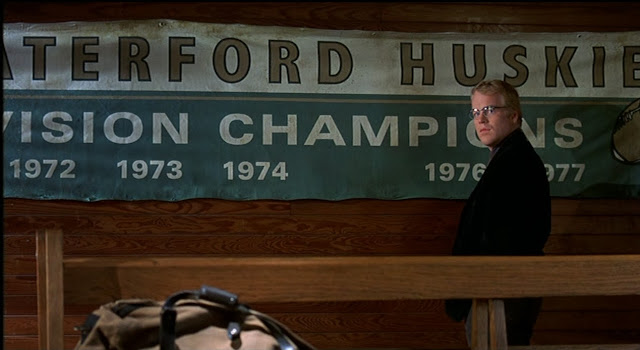
Plus: Michael Higgins (doctor), Rebecca Pidgeon, Clark Gregg, Charles Durning, Sarah Jessica Palmer, David Paymer.
Shot by Oliver Stapleton.
"They're holding the old mill to ransom."
"The only second chance you get is the chance to make the same mistake again."
"You've got to get me main street for nothing."
"I need that dead horse scene."
"It looks like Edith Head puked and the puke designed these costumes."
 |
| Macy, Paymer and doctor Michael Higgins in background |
And
"What does he like?"
"14 year old girls."
"Well get him half of a 28 year old girl."
The actor in question is Alec Baldwin and the (in fact 19 year old) girl Julia Stiles, but it's William H Macy's film as the director.

Philip is a compromised screenwriter.

Plus: Michael Higgins (doctor), Rebecca Pidgeon, Clark Gregg, Charles Durning, Sarah Jessica Palmer, David Paymer.
Shot by Oliver Stapleton.
Love Liza (2002 Todd Louiso)
With Philip Seymour Hoffman's premature death from heroin overdose, Love Liza is a painful watch, with the actor clearly mining his own addictive personality in soulful story of petrol-addicted man mourning suicide of his wife. It's perhaps his best performance and an eerily fitting obituary.


J.D. Walsh provides some comic relief as a remote controlled boat enthusiast, Stephen Tobolowsky a disappointed employer.
 |
| Outstanding superimposition of PSH and Kathy Bates by (gasp) female DP Lisa Rinzler |


J.D. Walsh provides some comic relief as a remote controlled boat enthusiast, Stephen Tobolowsky a disappointed employer.
Wednesday, 5 February 2014
Breaking Bad Season 5 (2012-13)
Walt (and Skyler) has become a monster and as the bodies pile up we're left with precious few to root for. Echoes Treasure of the Sierra Madre and ends up as a spaghetti western.
Has one of their unforgettable beginnings ( a boy riding his motorbike through the sand dunes) and we think "What's that all about?" Then there's a perfectly executed train heist....
It's been a gripping journey and ends in the only way it could have that was somewhat pleasing but it was not, I think, the greatest thing ever (its user rating on IMDB is a ridiculous 9.6/10). Also I don't think the money scheme would have worked (Walt Jr and Skyler would have known where it came from and refused it; the charity would have no way of explaining the sudden appearance of $10m; the DEA would have pounced).
Well acted though, and frequently brilliant in its storylines, it's been a pleasure watching an intelligent man thinking his way out of situations. It appears that Vince Gilligan did not have the whole story figured out from the start. He reportedly was surprised that no matter how bad Walt became, the diehard fans remained loyal to him. Personally I found that left a big vacuum and all we were left with was the Poor Jesse Show.
Robert Forster appears in latter episodes.
Shots from Dave Bunting's series of cinematography highlight videos:


Has one of their unforgettable beginnings ( a boy riding his motorbike through the sand dunes) and we think "What's that all about?" Then there's a perfectly executed train heist....
It's been a gripping journey and ends in the only way it could have that was somewhat pleasing but it was not, I think, the greatest thing ever (its user rating on IMDB is a ridiculous 9.6/10). Also I don't think the money scheme would have worked (Walt Jr and Skyler would have known where it came from and refused it; the charity would have no way of explaining the sudden appearance of $10m; the DEA would have pounced).
Well acted though, and frequently brilliant in its storylines, it's been a pleasure watching an intelligent man thinking his way out of situations. It appears that Vince Gilligan did not have the whole story figured out from the start. He reportedly was surprised that no matter how bad Walt became, the diehard fans remained loyal to him. Personally I found that left a big vacuum and all we were left with was the Poor Jesse Show.
Robert Forster appears in latter episodes.
Shots from Dave Bunting's series of cinematography highlight videos:


Like a complete idiot, I'd totally missed the reference to the real Heisenberg, referenced elsewhere in these jottings, an eminent physicist who amongst other things came up with the uncertainty principle.
Monday, 3 February 2014
The Savages (2007 Tamara Jenkins)
Perceptive look at how adult siblings cope with managing aging, estranged father.
Philip Seymour Hoffman and Laura Linney are as good as you'd expect; so is Philip Boscoe as Dad.
Tamara has done nothing since.
Philip Seymour Hoffman and Laura Linney are as good as you'd expect; so is Philip Boscoe as Dad.
Tamara has done nothing since.
Sunday, 2 February 2014
The Talented Mr Ripley (1999 Anthony Minghella)
I'm not sure we picked the greatest tribute to Philip Seymour Hoffman, who died today aged 46, as he's not in it a great deal. In fact the recently viewed Jack Goes Boating is a much more fitting memorial.


However he makes a good impression here, and following Jude Law's execution, we need another strong character to fill the void left from his Force Ten super-charismatic performance.
The film is superbly edited by Walter Murch and is a textbook example of the marriage of film images (John Seale) and sound.
But the film seems to go on for ever, even though it's only two and a quarter hours, and Damon can't sustain it (perhaps the character is the problem). With Cate Blanchett, Gwyneth Paltrow and Jack Davenport, from Patricia Highsmith novel.
Nice locations though (Ischia, Positano, Venice, Rome).


However he makes a good impression here, and following Jude Law's execution, we need another strong character to fill the void left from his Force Ten super-charismatic performance.
The film is superbly edited by Walter Murch and is a textbook example of the marriage of film images (John Seale) and sound.
But the film seems to go on for ever, even though it's only two and a quarter hours, and Damon can't sustain it (perhaps the character is the problem). With Cate Blanchett, Gwyneth Paltrow and Jack Davenport, from Patricia Highsmith novel.
Nice locations though (Ischia, Positano, Venice, Rome).
Body Heat (1981 Lawrence Kasdan & scr)
Begins in exactly the same smart, double entendre wisecracking way as a Big Sleep, but it's quickly apparent we're in Double Indemnity territory, with added candid sex scenes between William Hurt and Kathleen Turner (can you imagine seeing Bogie and Bacall screwing? It doesn't bear thinking about!) John Barry's score begins great, back in his jazz sax and trumpet days, but then becomes a bit more routine, which is a shame.
Sweaty Florida action nicely shot (with bags of diffusion) by Richard H Kline (The Boston Strangler) and edited by Carol Littleton (The Big Chill, The Rum Dairies).

With Richard Crenna, Ted Danson, J.A. Preston, Mickey Rourke.
Good film noir update.
Sweaty Florida action nicely shot (with bags of diffusion) by Richard H Kline (The Boston Strangler) and edited by Carol Littleton (The Big Chill, The Rum Dairies).

With Richard Crenna, Ted Danson, J.A. Preston, Mickey Rourke.
Good film noir update.
Saturday, 1 February 2014
And Soon the Darkness (1970 Robert Fuest)
Pamela Franklin keeps a cool head when friend Michelle Dotrice disappears on a bright and sunny French road, populated by sinister farm labourers and other slightly hostile inhabitants. Robert Fuest's treatment is inventive when you consider this sort of thriller material is often reserved for night, frequently providing creepy shots of the road, distant motorbikes, the woods etc. But Brian Clemens and Terry Nation's script really fucks up in the behaviour of French policeman Sandor Elès (why does he ruin the dead girl's film, for example?) and spoils an otherwise tense and inventive film.

Some of the pop music (including the theme music) sounds really awful.

Some of the pop music (including the theme music) sounds really awful.
Enchanted April (1935 Harry Beaumont)
Substantively the same story as we've more recently been used to, this feels like it's more than a few miles away.

Ann Harding is the free spirit with Shop around the Corner's Frank Morgan as her author / husband, and Katharine Alexander and Reginald Owen, Jane Baxter and Jessie Ralph (known to us for giving Nick a hard time in After the Thin Man), and Ralph Forbes as the somewhat strange host.
A studio set RKO production scored by Roy Webb and shot by Edward Cronjager it at least benefits from concision (66 minutes). Elizabeth von Arnim's 1922 novel 'The Enchanted April' was converted first into a Broadway play.

Ann Harding is the free spirit with Shop around the Corner's Frank Morgan as her author / husband, and Katharine Alexander and Reginald Owen, Jane Baxter and Jessie Ralph (known to us for giving Nick a hard time in After the Thin Man), and Ralph Forbes as the somewhat strange host.
A studio set RKO production scored by Roy Webb and shot by Edward Cronjager it at least benefits from concision (66 minutes). Elizabeth von Arnim's 1922 novel 'The Enchanted April' was converted first into a Broadway play.
Thursday, 30 January 2014
Breaking Bad Seasons 3 & 4 (2010-11 Vince Gilligan)
Bryan Cranston, Aaron Paul, Anna Gunn, Dean Norris, Betsy Brandt, RJ Mitte, Giancarlo Esposito (Gus), Bob Odenkirk (Saul the solicitor), Jonathan Banks (Mike).
Music Dave Porter. Photography Michael Slovis. Editing Skip MacDonald.
Contains one of the most memorable openings ever to a TV show (Mexicans sliding through the dirt like worms).
I love the way Walt is always thinking, trying to get a move ahead (frequently it's a chess game), though at one point he admits Gus is always 10 steps ahead of him.
Also the clever way in which the characters are pulled in all sorts of ethical and motivational directions, which constantly makes you change your feelings about them.

According to a most interesting interview with Michael Slovis "the most technically complicated shot was all that stuff in that room flying off of shelves, in the magnet episode [which he directed]. There were wires pulling everything, and they all had to be painted out by hand". You wonder whether it might have been easier to build the set on its side. Anyway, it is an amazing scene.
Music Dave Porter. Photography Michael Slovis. Editing Skip MacDonald.
Contains one of the most memorable openings ever to a TV show (Mexicans sliding through the dirt like worms).
 |
| A cloud passes under the sun, casting a moving shadow, in this fine scene. |
I love the way Walt is always thinking, trying to get a move ahead (frequently it's a chess game), though at one point he admits Gus is always 10 steps ahead of him.
Also the clever way in which the characters are pulled in all sorts of ethical and motivational directions, which constantly makes you change your feelings about them.

According to a most interesting interview with Michael Slovis "the most technically complicated shot was all that stuff in that room flying off of shelves, in the magnet episode [which he directed]. There were wires pulling everything, and they all had to be painted out by hand". You wonder whether it might have been easier to build the set on its side. Anyway, it is an amazing scene.
Wednesday, 29 January 2014
Intolerable Cruelty (2003 Coen Brothers)
Clooney is divorce lawyer obsessed by the whiteness of his teeth (not sure whether this is written into the script or if he is sending up film stars including himself) who tangles with gold-digger Catherine Zeta-Jones. Paul Adelstein is the soft-hearted colleague. With Geoffrey Rush, Edward Herrmann (as 'Rex Rexroth'!), Cedric the Entertainer, Richard Jenkins and Billy Bob Thornton.
Usual crew: Carter Burwell, Roger Deakins, Roderick Jaynes (!).

Film is a lot of fun.

Usual crew: Carter Burwell, Roger Deakins, Roderick Jaynes (!).

Film is a lot of fun.

Ship of Fools (1965 Stanley Kramer & prod)
1933. German liner sails home from Mexico, captained by Charles Korvin, with Oskar Werner as ship's doctor. Passengers include Vivien Leigh, Simone Signoret, George Segal and Elizabeth Ashley, Lee Marvin, José Ferrer, Heinz Rühmann (who - echoing another character's story - really did marry then divorce a Jewish woman, and was a favourite actor of Hitler) and dwarf Michael Dunn (No Way to Treat a Lady), who is the most likeable character.

Long film is lumpy like an old bed: all the plot is developed through talk, and the bigger scenes such as those involving Spanish refugees seem turgid.
Its fairly ordinary photography won Ernest Laszlo an Oscar. Werner, Signoret and Dunn deserved their nominations.

 |
| Heinz Rühmann and Martin Dunn |
Long film is lumpy like an old bed: all the plot is developed through talk, and the bigger scenes such as those involving Spanish refugees seem turgid.
Its fairly ordinary photography won Ernest Laszlo an Oscar. Werner, Signoret and Dunn deserved their nominations.
Tuesday, 28 January 2014
L'Amour en Fuite / Love on the Run (1978, released 1979 François Truffaut)
And so we reach the conclusion of this wonderful cinematic experiment (Satyajit Ray's Apu trilogy did not feature the same central actor) from which you can chart the career of Suzanne Schiffman, who starts out as a script girl on the second film but who by now co-writes and is first assistant director. Admittedly this chapter does feature too many and too long clips from the previous films (particularly evident if you have watched them back to back) but is not without its charms, as Doinel chances upon his ex Colette (Marie-France Pisier again, also a co-writer) whilst divorcing Claude Jade, and trying to have a relationship with Dorothée, who he has been introduced to through a torn up photograph.
Léaud is incapable of a false moment as our quixotic adventurer.

Léaud is incapable of a false moment as our quixotic adventurer.
Shot by Néstor Almendros. Music by George Delerue.
Antoine's step-step father is played by Julien Bertheau, the Monsignor from Buñuel's Discreet Charm of the Bourgeoisie. And his attempt to partly reconcile son and mother takes place at Montmartre cemetery, where the director himself ended up.
Love at 20 - Antoine Doinel episode (1962 François Truffaut)
A section from the multi-director L'Amour à Vingt Ans this constitutes Antoine Doinel Episode 2 (and thus should not be omitted). Jean-Pierre Léaud is now a young, independent man with job at Philips record production, and his own apartment and record player (he's getting into the classics and attends lectures on experimental music), who falls for Colette (Marie-France Pisier) at a concert. Setting the pattern for the later films, he becomes friendly with her parents, but she doesn't seem romantically interested in him.
The scene at the concert where he and the girl begin to notice each other is wonderfully cut (by Claudine Boucher); film is shot by Raoul Coutard in widescreen and ends with a series of photos by Henri-Cartier Bresson.
The scene at the concert where he and the girl begin to notice each other is wonderfully cut (by Claudine Boucher); film is shot by Raoul Coutard in widescreen and ends with a series of photos by Henri-Cartier Bresson.
 |
| I know.. It's because it's a screen shot from L'Amour en Fuite which has cropped the original.... |
Monday, 27 January 2014
My House in Umbria (2003 Richard Loncraine)
British ex-pat Maggie Smith takes in fellow victims of train bombing Ronnie Barker (good as ever), Benno Furmann, and mute child Emmy Clarke. They are visited by inspector Giancarlo Giannini and the girl's estranged uncle Chris Cooper.
I found the way Smith's character kept on at the grumpy Cooper a bit annoying, though the film is deeper than it might have been.
I found the way Smith's character kept on at the grumpy Cooper a bit annoying, though the film is deeper than it might have been.
Domicile Conjugal / Bed and Board (1970 François Truffaut)
Two years later, Doinel is married to Christine, and busily engaged in changing the colours of flowers! I can't at the moment identify the little apartment block (the address she gives for the taxi, 17 Rue Descazes, seems made up?)*, which has an interesting private courtyard set off a busy street. Certainly the various occupants remind me a little of Rear Window. Absolutely as good as the preceding three episodes.
Packed with great details and incidents, viz:
The apartment block's 'strangler'.
Antoine's totally pointless job piloting model ships.
A 'friend' who keeps borrowing money.
Antoine's boredom in meal at which he keeps making telephone calls.
The opera singer who is always on time but whose wife isn't.
And why shouldn't Truffaut speed up the shot of flower petals opening to reveal their secrets?

With Madamoiselle Hiroko. Written by Truffat, Claude Givray and Bernard Revon. Distinctive music as before by Antoine Duhamel, and edited by Agnès Guillemot. This is the second of several collaborations with cinematographer Néstor Almendros.
* I later learn in de Baeque / Toubiana's excellent biography Truffaut that it's in Sèvres-Babylone in the sixth. Which in turn takes me here where our French cinéastes identify the address as 133 Rue de Sèvres. Thanks!
Packed with great details and incidents, viz:
The apartment block's 'strangler'.
Antoine's totally pointless job piloting model ships.
A 'friend' who keeps borrowing money.
Antoine's boredom in meal at which he keeps making telephone calls.
The opera singer who is always on time but whose wife isn't.
And why shouldn't Truffaut speed up the shot of flower petals opening to reveal their secrets?

With Madamoiselle Hiroko. Written by Truffat, Claude Givray and Bernard Revon. Distinctive music as before by Antoine Duhamel, and edited by Agnès Guillemot. This is the second of several collaborations with cinematographer Néstor Almendros.
* I later learn in de Baeque / Toubiana's excellent biography Truffaut that it's in Sèvres-Babylone in the sixth. Which in turn takes me here where our French cinéastes identify the address as 133 Rue de Sèvres. Thanks!
Baisers Volés / Stolen Kisses (1968 François Truffaut)
Antoine Doinel has grown up, been kicked out of the army (where he's still reading Balzac) and becomes a hotel night porter then a private detective, whilst intermittently wooing Claude Jade and shoe shop boss Michael Lonsdale's wife, Delphine Seyrig. (There's also a comedy show version of Marienbad in the film's sequel.) Making much use of Sacré-Coeur and Montmartre.
Written by Truffaut and Claude de Givray. Photographed by Denys Clerval, edited by Agnès Guillemot (many Godards and Truffauts, her career ended with the controversial Romance by Catherine Breillat); with distinctive music by Antoine Duhamel.
A bouncy, effervescent film with many quiddities, such as the mysterious stalker, the underground Paris postal system, Léaud's monologue into the mirror, and the private detective firm's clearly gay client.
Cast also features Harry-Max (detective), André Falcon (his boss), Daniel Seccaldi (Claude's dad) and Marie France Pisier, as Colette, the good-looking ex Doinel bumps into from the previous instalment Antoine et Colette (1962 short).
Dedicated to Henri Langois, president of the Cinémathèque Français who had been sacked from his position but reinstated after protests instigated by Truffaut and supported by students and the international film community. The importance of this institution to the young nouvelle vague is well captured in Bertolucci's otherwise distasteful The Dreamers.
Written by Truffaut and Claude de Givray. Photographed by Denys Clerval, edited by Agnès Guillemot (many Godards and Truffauts, her career ended with the controversial Romance by Catherine Breillat); with distinctive music by Antoine Duhamel.
A bouncy, effervescent film with many quiddities, such as the mysterious stalker, the underground Paris postal system, Léaud's monologue into the mirror, and the private detective firm's clearly gay client.
Cast also features Harry-Max (detective), André Falcon (his boss), Daniel Seccaldi (Claude's dad) and Marie France Pisier, as Colette, the good-looking ex Doinel bumps into from the previous instalment Antoine et Colette (1962 short).
Dedicated to Henri Langois, president of the Cinémathèque Français who had been sacked from his position but reinstated after protests instigated by Truffaut and supported by students and the international film community. The importance of this institution to the young nouvelle vague is well captured in Bertolucci's otherwise distasteful The Dreamers.
Subscribe to:
Posts (Atom)